
Building an Agentic AI Framework: A Four-Step Action Guide for CIOs
In a keynote address on Tuesday, Info-Tech Research Group CEO Tom Zehren stated that although agentic AI has transformative potential for enterprises, technology leaders such as CIOs still face deployment challenges. He proposed a four-step framework based on surveys and industry research to help technology leaders develop an AI strategy that measures value, and emphasized that security measures, IT budgets, AI strategy, and employee buy-in are key factors.
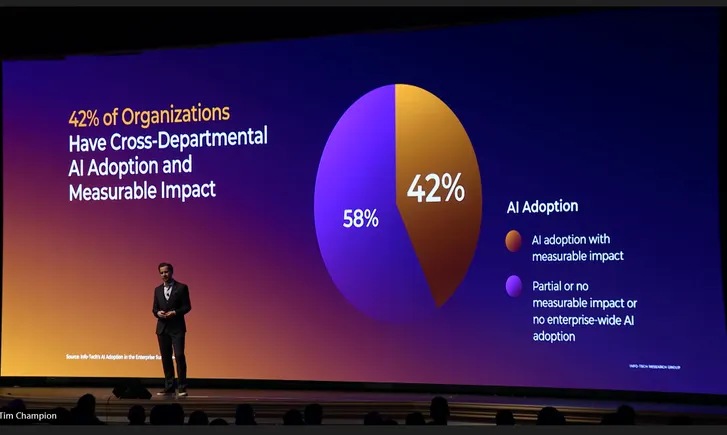
Despite the transformative potential of agentic AI for enterprises, CIOs and other technology leaders still face numerous challenges when deploying the technology within their organizations. So said Tom Zehren, CEO of Info-Tech Research Group, during the company's keynote on Tuesday.
Security measures, IT budgets, AI strategies, and employee buy-in all influence whether technology leaders succeed or fail in their AI initiatives.
"We live in a world with significant tension between AI value creation and AI governance and risk management," Zehren noted. He added that some organizations are stalled in their AI adoption goals due to fear of risk. Rejecting AI projects avoids risk but also blocks potential value.
According to Info-Tech surveys over the past year, more than a third of organizations have integrated AI governance into their regular IT strategies. Zehren mentioned that half of organizations report having a dedicated AI-focused strategy governed by their boards, which makes them twice as likely to derive value from AI.
Based on survey feedback and the company's industry research, Zehren proposed a four-step framework to help technology leaders find AI strategies with measurable value. First, organizations need to establish "their AI foundation," a set of mission requirements that include AI literacy, operating models, budgets, and ownership structures.
Second, use clean data, intelligent architecture, partnerships, and agile funding to determine which projects are long-term. Third, strengthen AI execution and create conditions for scaling. When organizations establish sandbox environments that are easy to use and meaningful to employees, safe experimentation can proceed. At this stage, organizations exercise the governance capabilities built in the first step and test the limits and value of the system.
In the final step, organizations seek to prove the value of AI projects, track benefits, scale prototypes, gather insights, and decide whether to stop or continue investing.
Successful AI strategies
Teams that succeed are often those that already have a strong grasp of business processes, logic, and their teams, while also understanding the technology.
Zehren advised: "Our recommendation is: don't lay off half your team, don't drastically cut IT capacity. Repurpose it." He believes the CIO role is shifting to that of a manager and coordinator of these systemic changes. CIOs are more commonly taking on broader responsibilities, such as measuring business outcomes, and serving in roles across digital, data, transformation, and even product departments.
Zehren said successful technology adoption could help them advance—according to a Deloitte report, 67% of CIOs say they aspire to become CEO.
"CIOs must step up and become exponential IT leaders, truly leveraging technology to create exponential value for their organizations," Zehren said. "If they do that, a wealth of new career paths will open up."