
Micron addresses high-demand memory market with smart manufacturing
Micron Technology is leveraging smart manufacturing technologies to meet strong demand for memory chips in sectors such as automotive and industrial IoT. Its Manassas facility plans to invest $3 billion by 2030, add over a thousand jobs, and deploy AI-based image and acoustic analysis systems to achieve a zero-defect goal.
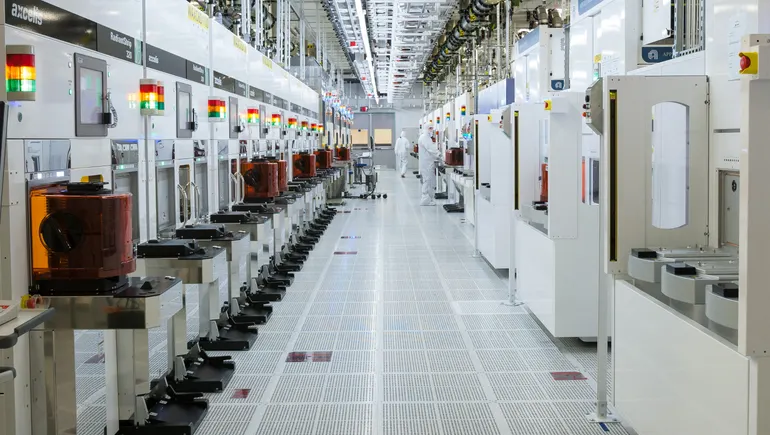
MANASSAS, Virginia - From the outside, Micron Technology Inc.'s manufacturing facility here is unremarkable. Despite its massive size, its ordinary box-like buildings do not reveal the intricate machinery operating within. Inside this highly secure facility, workers in protective suits bustle through thousands of square feet of cleanrooms, hidden from outside view.
The only hint of the plant's scale is the heavy equipment currently expanding the semiconductor manufacturing facility. The company plansto invest $3 billion by 2030and create more than 1,000 jobs over the next decade.
Micron, headquartered in Boise, Idaho, is one of the world's largest semiconductor companies. According to its fiscal year report released in September 2018, itsrevenue reached $30.4 billion, a 50% increase year-over-year. In the U.S. market, its revenue scale is second only to Intel - which reported in its fiscal year report released in January 2019 thatfiscal 2018 revenue was $70.8 billion, a 12% increase year-over-year.
With 12 manufacturing sites globally, Micron must keep pace with the growing demand for advanced memory technology from enterprises. In the early 2000s, its customers were primarily PC manufacturers like Dell and Lenovo. But today, smartphones, edge IoT devices, cloud computing, and data centers are driving continued growth in memory demand.

The primary role of the Manassas facility is to produce memory products - DRAM, NAND, and NOR - for automotive and industrial IoT applications, said Tim O'Brien, site director of Micron's Manassas facility, during a media roundtable in June. To expand its presence in this area, the company is investing in a global R&D center here.
Enterprises are eager to integrate smarter technologies and hope to enhance capabilities through memory improvements. Autonomous vehicles need sufficient storage capacity to keep up with rapid algorithm computations. Technological advancements require streamlined manufacturing processes to ensure product consistency and high-quality standards. To this end, companies are reducing the human element in manufacturing processes.
Automation and "smart factory" technology are "the next major revolution in manufacturing in terms of improving quality, efficiency, and cost," O'Brien said, and it "is probably the biggest revolution in truly improving manufacturing capabilities since robotics."

The backbone of the smart factory
Across industries, companies are striving to create more efficient manufacturing processes to support demand, with improved profit margins as a side benefit. Whether called smart factories, digital factories, or Industry 4.0, factories are evolving toward "smart manufacturing," said Steve Phillpott, CIO of data storage company Western Digital Corp.
This trend revolves around automation and analytics, Phillpott told CIO Dive:
The automation roadmap includes a full set of capabilities, from manufacturing execution systems to monitoring, applied in areas such as production line control, process control, and automated guided vehicles.
The analytics pillar includes devices such as audio or temperature sensors. The integration layer aggregates all data, enabling enterprises to perform advanced statistical analysis that influences decision-making and yield prediction.
When automation and analytics work together, physical and digital devices can be effectively orchestrated. "The automation side will generate a lot of data, and the analytics side will leverage that data," Phillpott said. "A lot of the effectiveness will revolve around the intelligence of how to use the data." When every element of the automation and analytics engine works in concert, companies can produce more efficiently. The problem is that machines can fail, and if any part of production goes wrong, it can propagate to the product.
For Micron, for example, it must ensure that memory products used in the automotive sector are top-quality. Customers in this sector do not want recalls due to memory chips, said Ted Doros, a data scientist at Micron, during the roundtable. Micron's expectation for every chip is zero defects - "absolute perfection." Micron also wants to remain competitive in the market, and automotive is a key growth area.
Despite slowing global automotive sales, technologies such as infotainment systems continue to support growth, said Sanjay Mehrotra, Micron's president and CEO, during the JuneMicron's third-quarter earnings call. Automotive and industrial business accounted for nearly three-quarters of the embedded business unit's revenue, which was $700 million in the third quarter, down 22% year-over-year. Micron remains confident in long-term demand. Mehrotra said that driven by megatrends such as AI, autonomous vehicles, 5G, and IoT, the memory market outlook is attractive.
Being as efficient as possible
To understand Micron's manufacturing, one must first understand its products. Micron receives 12-inch silicon wafers and transforms them into components of circuits, transistors, capacitors, and memory products. Incorporating automation and analytics helps Micron identify and resolve issues faster, O'Brien said, while also reducing variability and sharing insights across Micron's manufacturing network. "As we introduce new technologies, we can ramp up the yield curve faster and improve yields more quickly than ever before," he said. "From our perspective, this is a significant investment. It will help us achieve world-class levels in quality, cost, and efficiency."
Every manufacturing plant is experimenting with efficiency measures, but the Manassas facility focuses on acoustics and imaging. Image analysis and pattern recognition are among the first areas where AI excels, Doros said. Micron applies this to wafers, scanning for defects.

For decades, humans have been responsible for reviewing and classifying wafer quality. Micron applies deep neural networks to images, training an AI classification system. The system can distinguish between thin flakes, corrosion, or scratches, and according to company audits, its classification performance outperforms humans. Today, Micron classifies up to 2 million images annually that were previously done manually. "Humans may have differing opinions or experience fatigue, but AI systems do not tire; they run continuously and in a fraction of a second," Doros said.
Imaging is well-established in AI, but training acoustic systems is more complex. "Acoustics has always been a challenge. Vibration sensors on systems have existed for decades," Doros said, but "people avoid acoustics because they think it's too noisy." Micron uses AI systems for separation and full-spectrum analysis to examine acoustics and extract patterns.
For example, the Manassas facility applies acoustic analysis to equipment that interacts with expensive camera systems. Robotic systems transport wafers, coat them with photoresist, then transfer and bake the wafers before placing them in scanners (the camera systems). Doros said sensors already exist in the system, but microphones perform general listening. Bearing friction, component rubbing, or air leaks can all be captured acoustically. Micron can use spectrograms to "hear" and "see" changes. "Initially, we were just looking for changes in tool behavior, and it started from there," Doros said, "but we also treat spectrograms as images, just like Facebook does facial recognition, we do the same." He said, "It's actually a combination of natural language processing and facial recognition."
Micron runs spectrograms through convolutional neural networks (CNNs), a type of deep neural network commonly used for image analysis. It applies CNNs to sounds or sound images to classify "different words or syllables spoken by the robots," Doros said. The robots in the system have a "vocabulary," and Micron can identify what each robot is saying and determine if it remains consistent week to week. If a machine starts "saying" something different, Micron can identify product issues and halt production for preventive maintenance. This intercepts defects earlier and improves product quality.
Currently, Micron has deployed about 500 microphones at its Virginia facility, with expectations of approaching 5,000 in the future. The facility currently has 175,000 square feet of cleanroom space, but upon completion of the expansion, it will add 230,000 square feet of cleanroom space, equipped with sensors and microphones from the start.