
Observability urgently needs a paradigm shift: from data accumulation to goal-driven intelligent analysis
The author, with over thirty years of IT operations experience, believes that current observability practices fail to address fundamental issues and are instead worsened by data explosion, tool fragmentation, and increased manual troubleshooting burdens. The article proposes shifting from bottom-up data collection to top-down purpose-driven analysis, and explores Causely's paradigm shift philosophy and the potential of Agentic AI in IT operations.
I have been deeply engaged in the IT operations field for over thirty years. Despite the industry being filled with talk of "transformation," many fundamental challenges remain unresolved, or have even intensified. The rise of modern DevOps and observability once promised to revolutionize how systems are monitored and maintained, yet the reality is that we have merely scaled up old problems: more data, more dashboards, more alerts, without yielding better outcomes.
The core issue lies in this: our understanding of observability is flawed. We need to shift from a bottom-up approach to a top-down paradigm shift. Instead of collecting all data from the bottom up, hoping to discover insights from it, we should start from the goals or desired insights and only collect data that helps infer those insights.
Part One: Recalling the Early Days of IT Operations
From the early days of IT operations, we have focused on "keeping systems running." At that time, systems were mostly monolithic, monitoring methods were primitive, and troubleshooting often required engineers to spend hours sifting through log files. A major incident meant a "war room" packed with engineers manually correlating data, trying to pinpoint the root cause of an outage.
As infrastructure grew increasingly complex, the industry's response was to pile on more tools, each promising to simplify the troubleshooting process. But in practice, these tools often just created more dashboards, more logs, and more alerts, leading to information overload. IT operations needed to evolve, which gave rise to modern DevOps, but we are still in the early stages of this transformation.
Part Two: Problems with Current Observability
Observability was supposed to address the above challenges by giving teams a deeper understanding of their systems. The idea was that by collecting and analyzing vast amounts of telemetry data (metrics, events, logs, and traces), organizations could gain better insights and respond to issues more quickly.
However, what we see instead is an explosion of complexity. The current observability landscape is characterized by:
- Too much noise:The sheer volume of logs and alerts makes it nearly impossible for engineers to separate meaningful signals from the data deluge.
- Too many tools:Enterprises rely on a fragmented ecosystem of monitoring, logging, and tracing solutions, leading to data silos and inefficiencies.
- Too much manual troubleshooting:Despite the abundance of data, engineers still spend most of their time manually diagnosing incidents, correlating logs, and responding to false alarms.
The promise of observability has not been fully realized because organizations remain focused on data collection rather than shifting toward intelligent data processing.
Part Three: Causely's Paradigm Shift
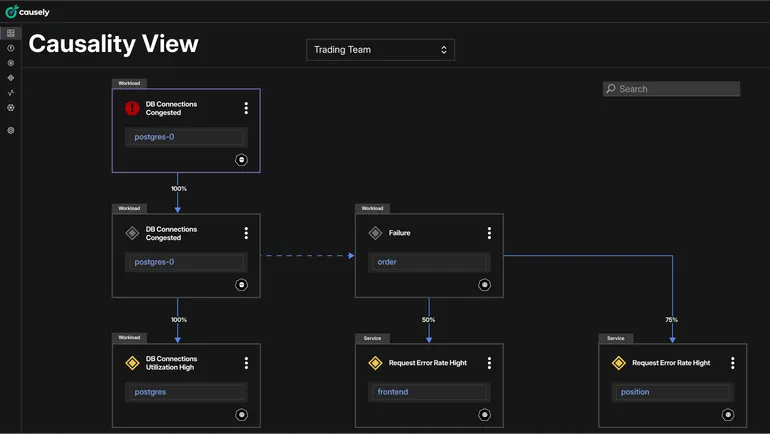
AtCausely, we believe observability must be disrupted and undergo a paradigm shift from bottom-up data collection to top-down, purpose-driven analysis, freeing engineers from hours of data sifting in search of the "cause behind the symptom." We reject the notion that engineers will always need to spend time drilling into dashboards and understanding tool data. Instead, we believe that implementing the right abstraction layer allows systems to manage themselves and removes humans from the troubleshooting loop. Engineers should not use tools that provide information for humans to analyze, but rather deploy systems that can make autonomous decisions.
This path toward autonomous service reliability is built on several core principles that I have outlined in arecent blog post. Moving from passively collecting data to relying on systems that actively interpret and act on insights is the future of observability.
Part Four: The Rise of AI and Agentic AI
We are at the threshold of a new era where Agentic AI can fundamentally reshape IT operations. No longer will engineers react to alerts; AI-driven systems will proactively maintain service reliability, predicting and preventing failures before they occur.
I am not referring to simple alert rules or anomaly detection, but true Agentic AI—one that continuously analyzes system behavior and adjusts in real time to prevent service degradation.
Causely is ready to lead this transformation, helping organizations move from reactive troubleshooting to proactive, AI-driven service reliability. This is not just an advancement in observability; it is a paradigm shift in how we think about IT operations.
Conclusion
For over thirty years, we have been tackling the same challenges in IT operations, just on a larger scale. It is time to rethink observability, move beyond endless data collection, and embrace a future where AI-driven automation ensures service reliability with minimal human intervention. Organizations that adopt this new paradigm will not only reduce downtime and incident costs but also allow engineers to focus on what truly matters: building the future.