
Walmart bets on AI and digital twins to reshape supply chain strategy
Before Walmart pushed AI to its 2 million employees, its supply chain team already relied on predictive models. Now, leveraging massive data, machine learning, large language models, and digital twin technology, Walmart is optimizing every step from receiving to delivery to balance assortment, speed, and cost, while quickly responding to sudden disruptions.
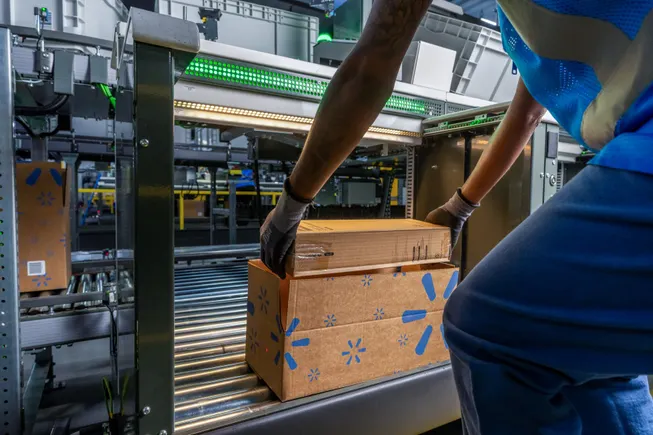
Before Walmart launched its initiative to expose 2 million employees to AI, the retail giant's supply chain team was already relying on the technology to help goods reach where they need to go.
Indira Uppuluri, senior vice president of supply chain technology at Walmart, told CIO Dive that predictive models have always had a place in the supply chain industry. But Uppuluri said her team now has access to more data and AI tools, providing stronger signals in what can sometimes be a challenging environment—"and that's where the industry is headed."
Uppuluri said data on weather patterns and customer purchase history, combined with machine learning techniques, has enhanced the insights the supply chain technology team can provide.
She added that Walmart can use popular large language models and open-source models in the enterprise. The data science and optimization teams also build custom AI tools to meet the business's needs and goals.
Walmart partners with OpenAI and Google to offer role-specific AI certifications through its employee learning platform Squiggly, which also encourages employees to build custom tools themselves.
The retailer's supply chain technology team manages its nodes—the locations where products are received, processed, stored, or shipped—as well as the fulfillment engine, which is responsible for sourcing inventory and optimizing the standards for customer delivery.
The team also manages the technology that guides outbound and inbound transportation and middle-mile logistics. This challenge is growing as same-day delivery becomes more common for large retailers. Walmart's Sam's Club launched a one-hour delivery service in April.
Agentic AI and digital twins
To optimize all the moving parts behind product management, Uppuluri said her team uses AI models and agents.
Instead of looking at one node at a time, employees can access agents to understand how the company's resources are being utilized overall and how to best optimize them or resolve bottlenecks.
"Category, speed, and cost are the three factors we try to balance and optimize in the supply chain," she added.
So far, 2026 has been a difficult year for supply chain leaders due to tariff and geopolitical turmoil. Extreme weather or environmental disruptions could intensify this challenge.
A large part of supply chain management is preparing for and reacting to events that could hinder goods from arriving. Uppuluri said sometimes her team can anticipate disruptions like weather, but other disruptions arise unexpectedly.
The same internal platform that helps move products efficiently also helps Walmart prepare for rapid and unexpected changes. Uppuluri's team uses modeling tools and digital twin technology to test how the network responds to facility closures, transportation delays, or sudden shifts in customer demand. The transportation team uses a virtual replica of the company's logistics network to simulate how goods move across the supply chain under stress.
"If a fire suddenly breaks out somewhere, how do you respond quickly?" she said. "The systems behind the scenes use data to suggest actions we can take, and our employees can adopt those recommendations and implement them for us."
Uppuluri said the supply chain industry is evolving with AI, from stochastic models to LLMs, and now to AI agents and agentic work. The mix of technologies they use will also evolve over time.
"The supply chain is evolving, and the models behind it are evolving too," Uppuluri said.
Note: This article has been updated to clarify that Uppuluri's team can anticipate disruptions like weather.