
How the NFL is reshaping its rookie scouting combine with data
The 2025 NFL Scouting Combine begins Thursday, with hundreds of players participating in four days of testing. The league, in partnership with AWS, has launched the Combine IQ dashboard, making advanced data visualizations available to the public for the first time, covering comparative rankings and draft scores for events such as the 40-yard dash and jumps. The tool, built on three years of sensor data, aims to reveal patterns behind the numbers and assist teams in making smarter decisions ahead of April's draft.
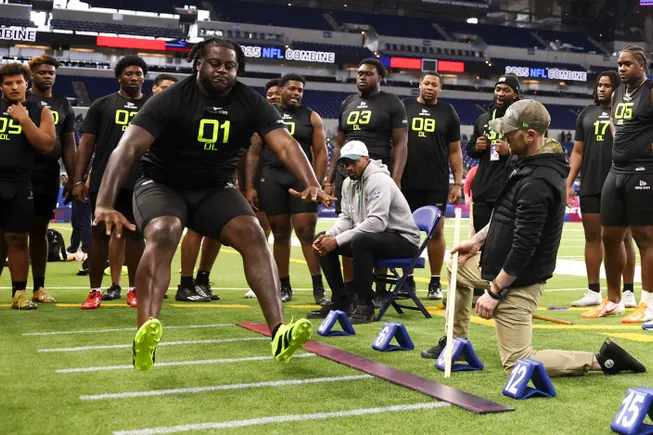
This week, the National Football League (NFL) welcomes hundreds of players with professional dreams, who will showcase their abilities at the 2025 NFL Scouting Combine. This four-day process of interviews and testing kicks off on Thursday, with teams evaluating players based on the 40-yard dash, a series of jumping drills, and multiple position-specific workouts.
Each test generates a massive amount of data points, which teams will analyze to determine their final selections for April's draft. However, traditional data tracking methods often lack the necessary context to support in-depth player evaluation.
"The combine itself can be a monotonous report of data points, but if you dig deeper into the data and connect the relevant clues, you can find patterns," Mike Band, senior manager of research and analysis for NFL Next Gen Stats, told CIO Dive. "You don't have to be the fastest player, but you have to be fast enough."
Using Amazon's AI-driven service Amazon QuickSight, the NFL and AWS jointly developed the Combine IQ dashboard, which debuted on Thursday, aiming to provide fans and analysts with intuitive data visualizations. The dashboard displays player comparative rankings and the Draft Score generated in collaboration with AWS, which measures athletic ability through historical comparisons and position-specific benchmarks, predicting a player's potential for success in the NFL.

This year's combine marks the first time fans and analysts can access these advanced data and analytics features through a dashboard powered by Next Gen Stats and Amazon QuickSight. It is also the second consecutive year that all 32 teams have received player tracking data, and the third year of data collection via sensors worn by participants.
"The real key is that you need to accumulate data points over multiple seasons to distinguish the true signal from the noise," Band said. "We feel that now that we will have three years of data—and the players from all three years have already played seasons in the NFL—clubs will be able to... parse speed and acceleration characteristics with a level of detail unprecedented in the history of the combine."
Data pipeline
Business leaders can relate to the NFL's need to make data more accessible and meaningful. Many enterprises remain hampered by poor data frameworks and management practices. According to a February report from SoftServe, nearly three in five business leaders say critical decisions are based on inaccurate or inconsistent data (link: https://www.ciodive.com/news/enterprise-data-woes-poor-outcomes-governance-management/739733/). Most respondents also admitted they don't know how to access the data they need.
The NFL accelerated its data pipeline upgrades through its partnership with AWS, which began in 2017. The league's proprietary player and ball tracking platform, Next Gen Stats, runs on AWS infrastructure, enabling teams to access advanced statistics that contextualize on-field actions.
As players showcase their strength and agility, biometric sensors will track their movement data with tenth-of-a-second precision. The NFL's Next Gen Stats team uses this data to compute machine learning models to calculate Draft Scores and generate other metrics.
The team formats the statistics and loads them into QuickSight's in-memory engine, which optimizes data query and visualization performance. An automated pipeline refreshes the data every five minutes, presenting the latest statistics to viewers.
"While I led most of the dashboard's construction, we have a team of research analysts who assisted throughout the process, whether it was handling the actual data, retraining models, validating, or adding features," Band said.
According to Band, this project was relatively straightforward for NFL engineers. Most of the work on the public-facing dashboard involved improving the user interface.
"We've unlocked the ability to tell stories with statistics through Next Gen Stats, and the combine provides us with an opportunity to step outside the game itself and truly delve into the transition from college players to entering the NFL," Band said.