
Undersea Data Centers: How Microsoft's Project Natick Merges IT with Ocean Technology
Microsoft's Project Natick deploys data centers on the seabed, leveraging natural ocean cooling to reduce energy consumption. The project, in partnership with submarine manufacturer Naval Group, has completed its second-phase testing off the coast of Scotland. Despite uncertainties in renewable energy supply and environmental monitoring challenges, the experiment offers innovative ideas for the IT industry and may drive the development of renewable energy sources such as tidal power.
Editor's note: This article originally appeared in the CIO Dive archives and was first published in June 2018.
The ocean floor was once considered the exclusive domain of benthic organisms and occasional shipwrecks, but Microsoft is now working to make this area suitable for information technology infrastructure as well.
Before achieving this goal, humanity must overcome many challenges in ocean development—and there are still vast untouched waters in the ocean. The ocean's immensity, along with the ongoing search for energy-efficient alternatives, is one of the core reasons behind the creation of Project Natick: a convergence of information technology and submarine technology.
Cloud services, as a virtual alternative to on-premises data centers, place the primary responsibility for data center maintenance and functionality on cloud providers. As more enterprises adopt cloud services, vendors like Microsoft are actively seeking solutions to reduce server energy consumption, and one such solution happens to be located on the ocean floor.
Land-based servers consume significant energy and time for cooling and maintenance. To eliminate the pressure from external interference factors, Microsoft's research into underwater data centers continues, and Project Natick has entered its latest phase.
Ben Cutler, Project Natick program manager at Microsoft, admitted that when he first heard the idea of submerging computers in water, his reaction was "I wouldn't join that team." But when he re-examined the concept from an engineer's perspective, he found that although the idea of underwater computers is quite sophisticated and complex, it is not crazy—he said this in an interview with CIO Dive.
Project Natick has brought about a "marriage" of two industries: information technology and marine technology, and Microsoft has already mastered the former. The company turned to submarine manufacturer Naval Group for collaboration, which can provide renewable energy-related solutions to complement Microsoft's expertise in IT.
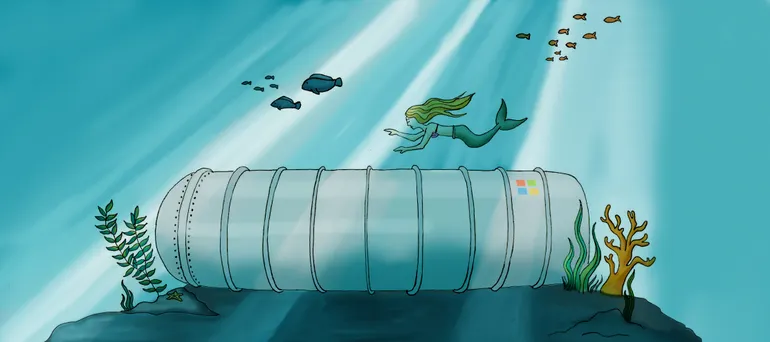
The design of the container references Naval Group's underwater structures. According to official Microsoft materials, it is secured by a triangular base and equipped with a "air-water dual system" to maintain cooling for the internal data center, operating on the same principles required for land-based data centers.
Microsoft's energy-saving exploration
Data centers are not inherently energy-efficient, but Cutler pointed out that "the idea of co-locating data centers with renewable energy is not new," yet this concept is indeed quite attractive.
Project Natick is not only a tribute to the name of a small town in Massachusetts but also Microsoft's pursuit of the frontier of renewable energy. Compared with "space-constrained" Europe, the United States has not fully utilized offshore wind power as an alternative energy source, but it is precisely this field that provided inspiration for the designers behind the project.
Tidal energy is generated by ocean currents and works similarly to wind turbines, but the equipment "sits on the seabed and moves back and forth with the water flow," Cutler explained. Wave energy technology is still in a "very early" stage, and such research is expected to advance its development.
Project Natick is an experimental attempt in an unexplored space within the IT field. Gary Cook, senior corporate campaigner for the climate and energy movement at Greenpeace, told CIO Dive: "This could be an innovative approach for the industry." He noted that by utilizing ocean cooling, the energy demands of land-based servers could be reduced.
However, due to the rapid expansion of the cloud market, Cook believes there is still uncertainty about whether Microsoft can "secure a stable supply of renewable energy in many markets."
Other Silicon Valley companies are also actively working to reduce their carbon footprint. As cloud services dominate the storage market, cloud providers must come up with creative solutions to reduce energy consumption.
According to Amazon's disclosures, by the end of 2016, approximately 40% of the electricity consumption of its global infrastructure came from renewable energy. AWS has 10 solar and wind farms, generating about 2.6 million megawatt-hours of energy annually, powering its data centers in Ohio and Northern Virginia.
Google, on the other hand, uses machine learning technology to understand how its data centers can achieve maximum efficiency. According to the company, early-stage models once told engineers that the best way to achieve complete energy savings was to "shut down the entire facility," and engineers had to teach the algorithm to become "a responsible adult."
Today, these models have helped Google reduce energy consumption by 40%, while wind and solar projects are also in practical use.
As for the direct environmental impact of underwater data centers, Cutler said that current data shows the difference is minimal. Due to ocean current movement, the water temperature around the container can basically self-regulate.
Cutler used an analogy: imagine pouring a cup of warm water into a river; the water temperature might rise slightly at the exact location of the pour but would quickly dissipate with the flow. In tests conducted off the California coast, research aboard the Leona Philpot found that the temperature difference was only a few thousandths of a degree.
Marine life is also a consideration, although Cutler admitted he is more concerned about potential damage to the container by California sea lion populations than the reverse. But researchers remain vigilant about the sound emitted by the servers, as marine mammals are particularly sensitive to hearing.
Researchers ultimately found that the sounds produced by large numbers of snapping shrimp completely masked any noise generated by the servers.
Nevertheless, Microsoft often ventures into topics beyond its core IT domain. "Look at Microsoft today; our CEO (Satya Nadella) genuinely believes that doing good for the world will ultimately benefit the company," Cutler said. Microsoft is gradually breaking down the barriers between industry and environmental protection.
Ultimately, "we are all citizens of the world," and if a company can strive to reduce its carbon footprint, it should do so, Cutler added.
The science behind underwater data centers
Traditional data centers are sensitive to external environmental interference, and even with proper maintenance, anomalies can occur. Part of protecting servers from interference involves preventing damage to their metal components.
Project Natick researchers removed oxygen and most water vapor from the container, creating a dry, nitrogen-rich environment. Cutler said this reduces the likelihood of corrosion in the "metal-to-metal connections" of most servers.
Even with gold-plated connectors, imperfections are inevitable, and moisture can seep in. Traditionally, connector analysis is performed when computer performance is abnormal. During inspection, connectors need to be retracted and existing corrosion "scraped off," he said. But if Project Natick goes according to plan, this process will be completely avoided.
As of now, it is unclear when Project Natick will transition from the research phase to commercial application. The second phase of Project Natick was launched off the coast of Scotland on June 1 and is planned to operate underwater for one year. During this period, Microsoft will collect data to assess the integrity of the infrastructure and its impact on the surrounding environment.
But the research project could also provide insights for land-based data centers. A land-based data center of similar scale to the underwater one could be used to compare the pros and cons of "lights-out operations" (i.e., data centers isolated from human interference).
Making data centers accessible to a broader population
A major appeal of submerged data centers is their detachment from the power grid. Data centers that rely on the grid lead to increased electricity usage because power must be transmitted over long distances via "high-voltage lines" and requires systematic boosting. According to Cutler, this long-distance transmission causes about 5% power loss.
According to the "United States Data Center Energy Usage Report" published in 2016, electricity consumption by U.S. data centers is projected to reach about 73 billion kilowatt-hours by 2020. The growth of "hyperscale" data centers is setting the tone for future electricity demand.
If energy can be produced and used locally, it can reduce the traditional power usage effectiveness (PUE) of data centers—which traditionally rely on batteries or generators. Instead, tidal energy, with the regularity of ocean currents, gives data centers a more predictable and reliable PUE. Electricity thus "integrates with its own storage system," Cutler said.
PUE is the ratio of total data center electricity usage divided by server electricity usage to determine overhead. For example, a PUE of 3 means that for every 1 watt used, 2 watts are used for other purposes. Over time, engineers have managed to reduce PUE from 4 or 5 to about 2 by designing architectures that control airflow.
Co-locating renewable energy allows data centers to eliminate the need for backup power solutions and instead have an energy surplus, simplifying operations.
But modern data centers are essentially "construction projects," which makes them unpredictable, Cutler noted. In contrast, the Natick project is approached with manufacturing and engineering processes, enabling rapid deployment and a more consistent experience.
There are too many factors such as terrain, climate, power supply, and personnel, but Natick introduces a truly sealed environment, so "all these problems are solved," Cutler concluded.